
Which Delivers Better Soft Light on Set? | Artemis
Which Delivers Better Soft Light on Set? | Artemis
A practical comparison of balloon lights and softboxes for film and studio soft lighting. Learn how Artemis spherical balloon lights differ in diffusion, deployment and scene requirements.
Balloon Light vs. Softbox: Which Delivers Better Soft Light on Set?
Soft light is not a single quality. A large source close to the subject produces gradual shadow transitions; a diffused source with the wrong shape or distance produces a flat, directionless wash. For cinematographers and small production companies choosing between a balloon light and a softbox, the decision is rarely about which one is “better.” It is about which one fits the set, the schedule, and the look.
This guide compares the two approaches using the operating characteristics of the Artemis spherical balloon light series, so you can evaluate where each option belongs in your lighting package.
What Does a Balloon Light Actually Do Differently?
A balloon light is a light source enclosed in an inflatable diffusion envelope. The envelope itself becomes the emitting surface: light passes through the treated fabric in all directions, producing a 360-degree soft source rather than a directional panel.
The Artemis spherical series uses this principle with HMI, tungsten, hybrid or LED light sources inside a helium-filled or air-filled balloon. The result is a source that behaves less like a lamp pointed at a subject and more like a small, controllable patch of overcast sky placed where you need it.
A softbox, by contrast, is a directional tool. It shapes light forward through a front diffusion panel. It is precise, repeatable, and familiar to most crews. But it also requires rigging, orientation, and a clear line of sight to the subject.
Key Differences That Affect the Decision
Consideration | Spherical Balloon Light (Artemis) | Traditional Softbox |
Emission pattern | 360° radial diffusion | Directional, forward-facing |
Shadow character | Extremely gradual falloff in all directions | Controlled by box size and distance |
Deployment | Inflate, rig or float, power on | Assemble frame, attach diffusion, rig |
Rigging requirements | Overhead clearance or helium for float; hanging points for air-filled | Stand, boom, or grid position |
Scene footprint | Overhead when appropriately floated or rigged; other mounting methods may use floor space | Requires floor or stand space in front of subject |
Best suited for | Wide ambient fill, moonlight simulation, large soft key from above | Controlled key light, interviews, tabletop, tight spaces |
Wind sensitivity | Relevant for outdoor helium use; air-filled less exposed | Lower profile, easier to shield |
When a Spherical Balloon Light Makes More Sense
You need soft light from above without a crane or a large frame.
A softbox large enough to wrap a wide shot must be rigged somewhere. Where ceiling clearance is sufficient and helium float is approved for the model, a balloon may be positioned overhead without a large frame; low ceilings can instead make helium impractical. The Artemis system is designed for this overhead ambient role: the balloon itself is the source, not a modifier attached to a separate fixture.
You want the soft source to disappear into the scene.
Because the balloon emits in all directions, it can light a space without a visible “light direction.” This is useful for night exteriors where the source should read as ambient sky, or for interiors where a conventional softbox would be visible in frame or cast an obvious edge.
You are lighting a volume, not a subject.
Softboxes are often chosen to flatter a face or a product. A balloon light is often chosen to raise the overall level of a space while keeping the quality soft. If the shot calls for atmosphere rather than a precise key, the balloon approach can reduce the number of units on set.
When a Softbox Is the Better Choice
You need directional control and precise falloff.
A softbox tells you where the light goes. For interviews, narrative close-ups, and product work, that directionality is an advantage, not a limitation. The Artemis spherical series is not designed to replace a softbox in these roles.
The ceiling is low, fragile, or unavailable.
Helium balloons need vertical space to float safely. Air-filled balloons need rigging points. If neither exists, a softbox on a stand is the practical solution.
You need a small, repeatable package for travel.
Softboxes pack flat. Balloons, even deflated, require envelope material, inflation equipment, and a power/control package sized to the fixture. For a one-person crew traveling light, a softbox remains the more portable option.
Technical Selection Notes for the Artemis Spherical Series
The following points are based on publicly listed Artemis specifications. Confirm current model data with your BTCOOPS contact before specifying a unit for production.
Balloon diameter: Artemis spherical versions are listed from 2.5m upward (helium filling). This is a large-format tool, not a small on-camera modifier.
Light source options: HMI daylight (5600K), tungsten (2900–3100K), hybrid and LED variants exist across the series. Color temperature and CRI/TLCI must be confirmed per model.
Inflation mode: Helium filling enables floating overhead; air filling is used for suspension or tripod-mounted configurations where float is not required.
Wind limits: Outdoor helium use is subject to wind restrictions. Maximum wind resistance varies by model and should be verified against the specific balloon size and site conditions.
Setup time: Published setup estimates for Artemis balloon systems vary by model and crew experience. Confirm the figure for your specific configuration with BTCOOPS.
If your scene requires a source smaller than 2.5m, the Artemis spherical series may not be the correct product. Discuss your requirements with BTCOOPS before planning a balloon-based approach.
How to Compare Light Quality on a Real Set
A fair comparison uses the same scene, camera exposure, subject position, and a documented mounting distance. Note each source’s emitting area, beam control, output setting, CCT and exposure. A larger source does not automatically create softer shadows if it is placed much farther from the subject.
Five measurements worth recording
1. Horizontal and vertical illuminance (lux) at marked subject positions; 2. uniformity across a defined set area; 3. shadow transition at a fixed subject-to-background distance; 4. spill onto the background and adjacent zones; 5. total rigging time and number of people involved. Record the test meter, ambient-light condition, and distance so the figures can be interpreted.
Example Lighting Decisions by Shot Type
Wide night exterior: consider a balloon for broad overhead ambient fill when local wind restrictions, anchoring, and power permit. Interview close-up: favor a gridded softbox for directional key control. Multi-camera studio: use a balloon for general ambience only after checking reflections, exposure uniformity, and camera flicker performance. A hybrid setup can use the balloon for ambient level and a softbox for motivated key light.
Questions to Ask Before Ordering
What area needs coverage, and at what working height? Is the goal ambient fill or directional key? Which precise Artemis model and inflation mode is proposed? What rigging and electrical supply exist? Is model-specific photometric information available? Request the fixture’s verified specification sheet and an application photograph matching the proposed configuration.
Supplemented technical evidence from Artemis manufacturer samples
Evidence classification: the figures below are published manufacturer-catalog specifications or a manufacturer lighting-chart example. They are not independently verified field measurements, site approvals, or guarantees for a different SKU. Confirm the current datasheet and installation manual before specifying equipment.
Manufacturer lighting-chart reference (not a matched softbox test)
The Artemis daylight cutsheet includes a photometric planning chart for Artemis Ellipse4800DL, a 4 × 1200 W HMI fixture. At a balloon height of 12 m (40 ft), the illustration labels approximately 292 lux near the chart center, 253 lux at 4 m horizontal offset, 216.3 lux at 6 m and 146.5 lux at 10 m. These are readings depicted in a manufacturer lighting chart, not fresh field readings and not a comparison with a softbox. They do not apply to Artemis spherical or LED models. [Source S1, p.3–4]
Distance from chart center | Catalog-chart illuminance | Applicability |
0 m | 292 lux | Ellipse4800DL, shown 12 m height |
4 m | 253 lux | Same illustrated chart |
6 m | 216.3 lux | Same illustrated chart |
10 m | 146.5 lux | Same illustrated chart |
A useful softbox comparison must keep camera settings, subject position and ambient exposure fixed; document fixture output, diffusion, angle, lux meter, and distances. Report actual shadow-edge and spill photographs next to the meter readings. Since no measured softbox baseline was supplied, this article does not state that Artemis is brighter, softer or quicker in an equivalent test.
Example of practical light shaping
The daylight brochure lists reflectors, CTS filters and black skirts as optional accessories. A black skirt or reflector can make a balloon more controllable, but the final beam distribution must be evaluated for the exact balloon and accessory arrangement. [Source S1, p.3]
What is still needed for an evidence-based verdict
· A matched balloon-versus-softbox test at the same subject position and documented working distance.
· Lux at center and perimeter, color data, shadow photographs and background spill readings.
· Crew count, setup/strike time and any required rigging for each exact configuration.
FAQ
Q: Can a balloon light replace a softbox entirely?
A: No. A balloon light is an ambient and volume-lighting tool. A softbox is a directional shaping tool. Most professional sets use both, for different purposes.
Q: Is a balloon light “softer” than a softbox?
A: Softness depends on the size of the emitting surface relative to the subject and the distance between them. A large balloon at a distance can be harder than a small softbox close to the subject. The balloon’s advantage is its 360-degree emission and overhead placement flexibility, not an inherent softness advantage.
Q: Do I need helium for every Artemis balloon setup?
A: No. Artemis balloons can be air-filled and suspended or mounted when floating is not required. Helium is used when the balloon must float without rigging.
Q: What is the smallest Artemis spherical balloon available?
A: Publicly listed Artemis spherical versions begin at 2.5m diameter. Confirm current availability with BTCOOPS.
Request a Specification Review for Your Production
Every set has different ceiling heights, rigging options, power access, and schedule constraints. Rather than specifying a balloon or a softbox from a general comparison, send us your scene parameters and we will tell you which Artemis configuration fits, or whether a different approach is more appropriate.
What to include in your inquiry:
Balloon diameter you are considering
Ceiling height or rigging availability
Power source and location
Shooting schedule and crew size
Whether float (helium) or suspension (air) is required
Source notes and verification boundary
· [S1] Artemis Balloon Lighting — Daylight 5600K, manufacturer cutsheet, pp. 3–4: HMI model dimensions, power, maximum luminous output, envelope volume, indicative setup times and Ellipse4800DL lighting chart.
· [S2] Fenigal Lighting Balloon — Film and Television Shooting, 2025 Product Brochure, pp. 5–13: product/application images, LED product family specifications and sphere/ellipse control and PSU options.
· [S3] PSU channel explanation, p. 1: example 16-channel effects/GEL priority and RGBA/white control notes; current SKU firmware and values require checking.
· Catalog imagery is not proof of a named customer project. Available uploads do not establish actual softbox comparison measurements, independently verified lux, rated suspension loads, site deployment costs or signed on-set records.
Product inquiry: https://www.btcoops.com/ | Manufacturer technical review required for model-specific configuration.
Controlled balloon-versus-softbox comparison: field-test protocol
A genuine same-condition comparison has not yet been conducted or supplied. The manufacturer Ellipse4800DL illuminance chart above is a single-fixture reference, not a measured comparison and not spherical-balloon performance. Do not present hypothetical readings as field measurements.
For a defensible test, record one exact Artemis configuration and one identified softbox fixture, use the same scene and sensor locations, and document two setups: (A) equal electrical input or measured fixture power, and (B) equal center illuminance (lux) at the subject. Report those protocols separately; neither alone proves overall superiority.
Field / metric | Artemis balloon — actual measured | Softbox — actual measured |
Exact fixture, source and diffusion | Pending real test | Pending real test |
Electrical power (W) and dim setting | Pending | Pending |
Source-to-subject distance (m) | Pending | Pending |
Illuminance at center (lux) | Pending | Pending |
Illuminance at ±2 m and ±4 m (lux) | Pending | Pending |
Shadow-edge reference / image ID | Pending | Pending |
Background spill (lux) | Pending | Pending |
Installation and strike time; crew size | Pending | Pending |
CCT / CRI / camera settings | Pending | Pending |
Interpretation rule: present the matching conditions and all measured values together. Note that source geometry and rigging requirements differ; avoid claiming one is universally softer, brighter, or faster without supporting results.
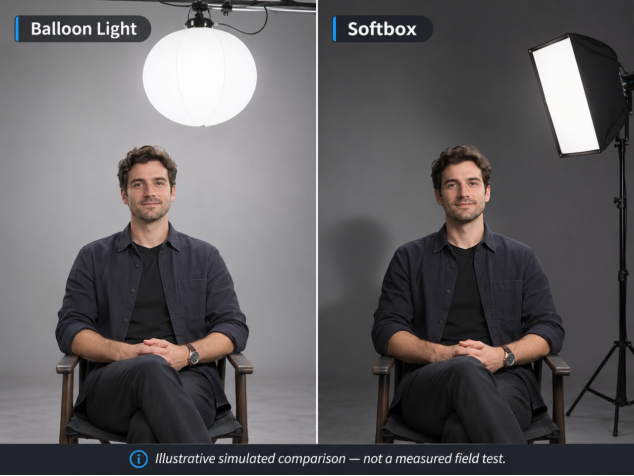
Illustrative Same-Scene Lighting Comparison (Not a Field Test)
The visual below is an illustrative simulated comparison prepared to help readers understand the likely difference in lighting behavior between a spherical balloon light and a directional softbox. It is not a measured field test and should not be interpreted as proof of brightness, softness or setup speed under matched conditions.
Figure: Illustrative simulated comparison only. Same subject and framing are shown to communicate likely light behavior, not measured performance.
How to interpret the illustration:
· Balloon Light side: illustration of broad overhead fill. The rendered shadow appearance is a visual concept, not a measured photometric characteristic.
· Softbox side: illustration of directional side lighting. A real comparison must control source size, distance, power and diffusion.
· Because this is a simulation, final purchasing or production decisions should still be based on a real same-scene test or documented field measurements.
Send Your Custom Product Requirement
Tell us the product family, intended application, size, quantity, operating conditions and delivery target. Your inquiry email will automatically include the page you are viewing so our team can understand the exact product, technology or reference that led to your request.
- Product family or model of interest
- Required size, quantity and customization
- Application, installation and operating environment
- Project country, operating conditions and delivery target