
Industrial Lighting Solutions for Worksites & Maintenance | BTCOOPS
Industrial Lighting Solutions for Worksites & Maintenance | BTCOOPS
Industrial Lighting Solutions: A Practical Guide for Worksites, Maintenance & Safety
Industrial lighting is essential for maintaining visibility, supporting safe working practices and enabling operations in areas where permanent lighting is insufficient or unavailable.
From night construction and road maintenance to factory shutdowns, logistics yards and temporary industrial facilities, different working environments require different lighting strategies.
For contractors, facility managers and equipment buyers, selecting an industrial lighting solution involves more than choosing a lamp with a high wattage rating. Light distribution, glare, mounting height, power availability, environmental exposure and deployment time can all influence the suitability of the equipment.
This guide explains where portable industrial lighting is used, how inflatable balloon lights compare with conventional floodlights, and what buyers should evaluate before selecting a temporary lighting system.
1. What Are Industrial Lighting Solutions?
Industrial lighting solutions are lighting systems designed to provide task illumination, area visibility or temporary operational lighting in industrial environments.
These environments may include:
Construction sites and infrastructure projects
Manufacturing plants and industrial workshops
Warehouses and logistics facilities
Road maintenance and utility service areas
Agricultural and remote industrial sites
Equipment inspection and plant shutdown operations
Temporary workstations and emergency maintenance areas
Industrial lighting may be permanently installed, temporarily mounted or designed as portable equipment.
Portable industrial lighting is particularly useful when the working location changes, permanent fixtures cannot be installed, or additional illumination is needed for a limited period.
The most appropriate solution depends on the job rather than the lighting technology alone.
2. Why Does Lighting Design Matter in Industrial Environments?
Industrial environments frequently contain moving machinery, vehicles, uneven surfaces, reflective components and workers performing detailed tasks.
In these environments, inadequate or poorly positioned lighting can create visibility problems.
Glare and visual discomfort
Concentrated lighting sources may create uncomfortable brightness when workers look toward the fixture.
Diffused lighting systems, including balloon lights, can help distribute light more softly and reduce direct glare in suitable layouts.
Shadows around equipment
Machinery, structural beams, shelving and vehicles can obstruct light.
A properly positioned elevated area light may reduce some harsh shadows, while localized task lighting remains necessary for detailed operations.
Temporary installation requirements
Maintenance contractors may need to relocate lighting several times during a single project.
Portable tripods, modular lighting systems and suitable power connections can support more flexible site operations.
Operational continuity
Lighting equipment must be selected for the required working period and available power infrastructure.
The design should consider operating duration, equipment access, backup arrangements and the consequences of a lighting failure.
3. Common Industrial Lighting Applications
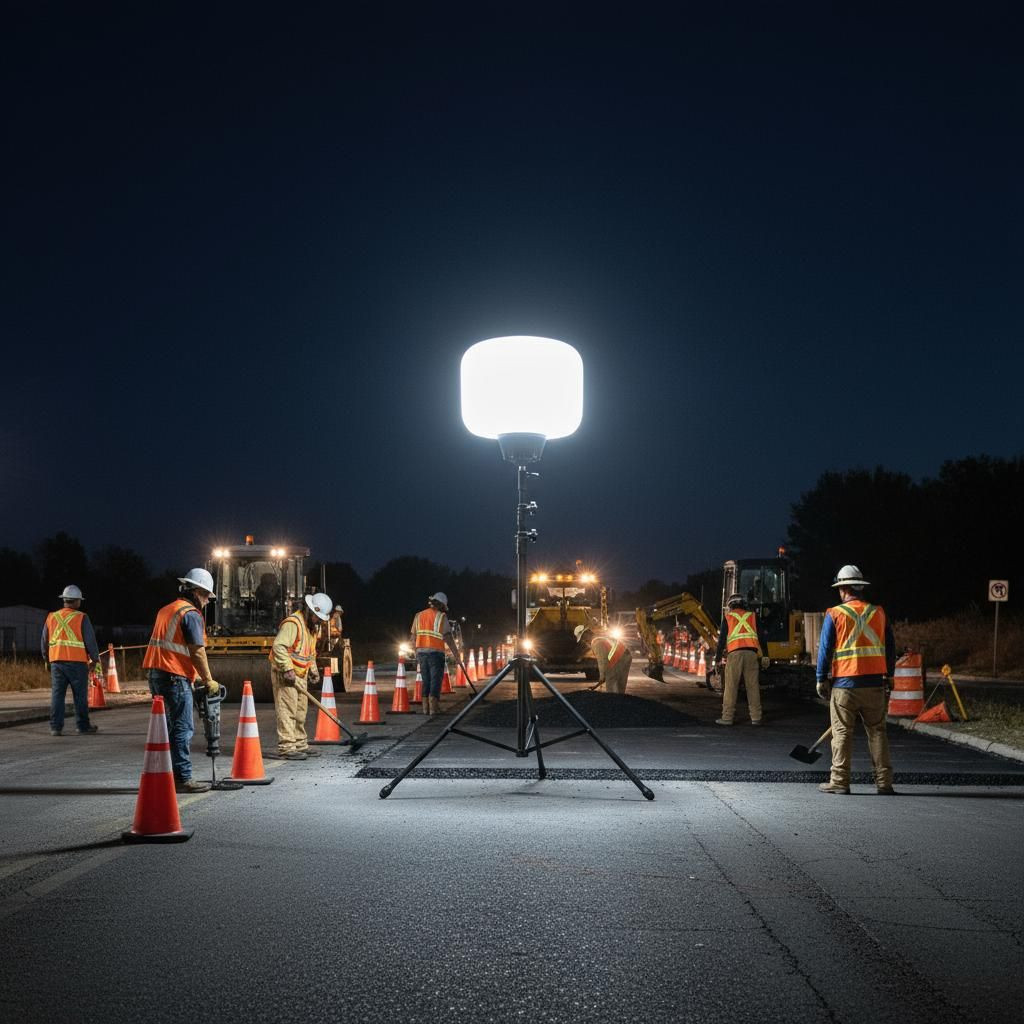
3.1 Night Construction and Infrastructure Projects
Night construction presents specific lighting challenges because temporary lighting must support workers, equipment operators and supervisors without creating excessive glare toward nearby traffic or adjacent working areas.
Typical applications include road construction, bridge maintenance, utility installation and building renovation.
Project requirements may include:
Broad illumination of temporary working zones
Supplemental lighting at machinery and inspection points
Relocatable installations as work progresses
Stable mounting and safe cable management
Appropriate outdoor protection and electrical compatibility
Recommended solution approach: Use portable diffused area lighting where broad visibility and glare control are important, supported by directional work lights where higher localized illuminance is required.
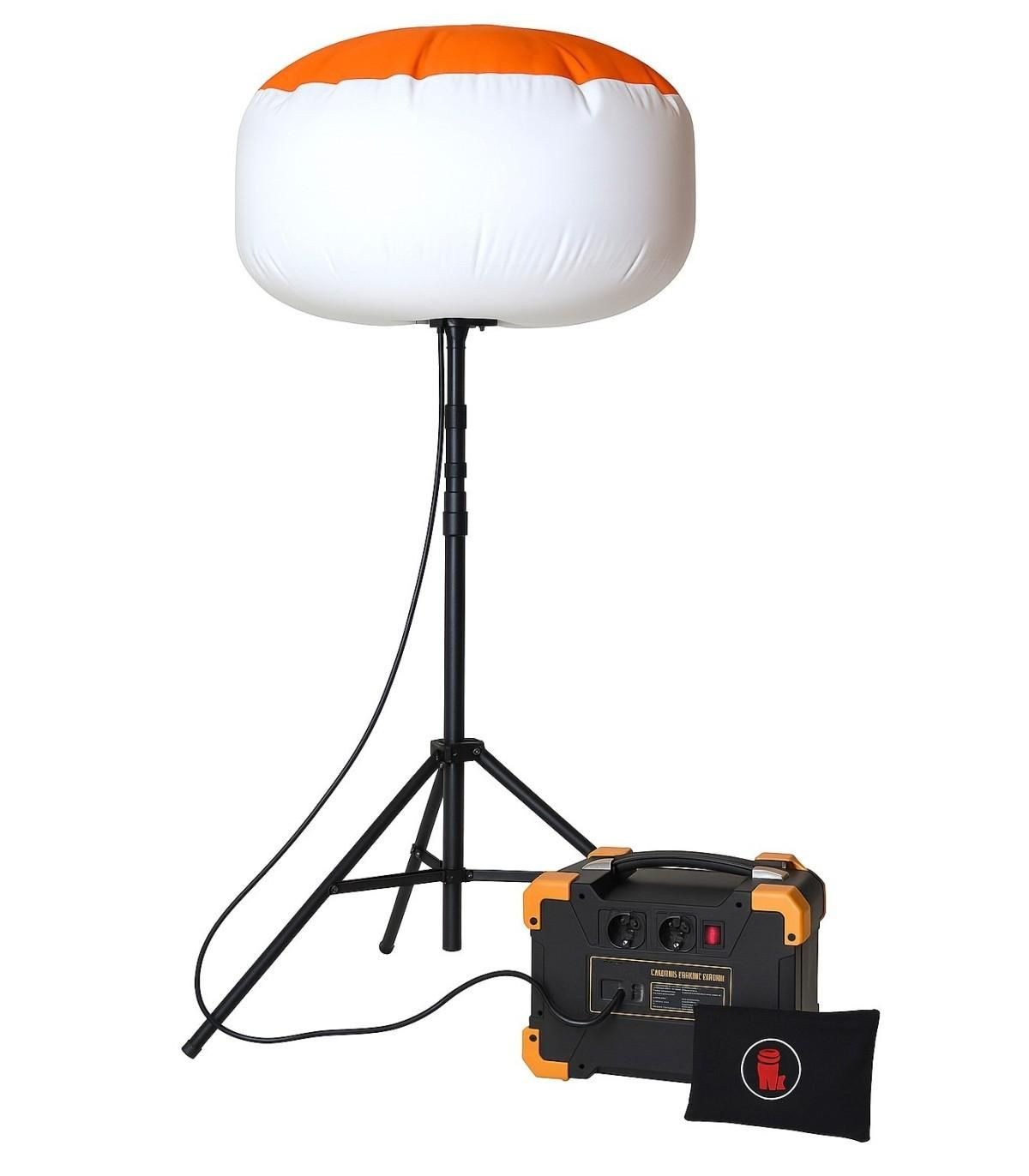
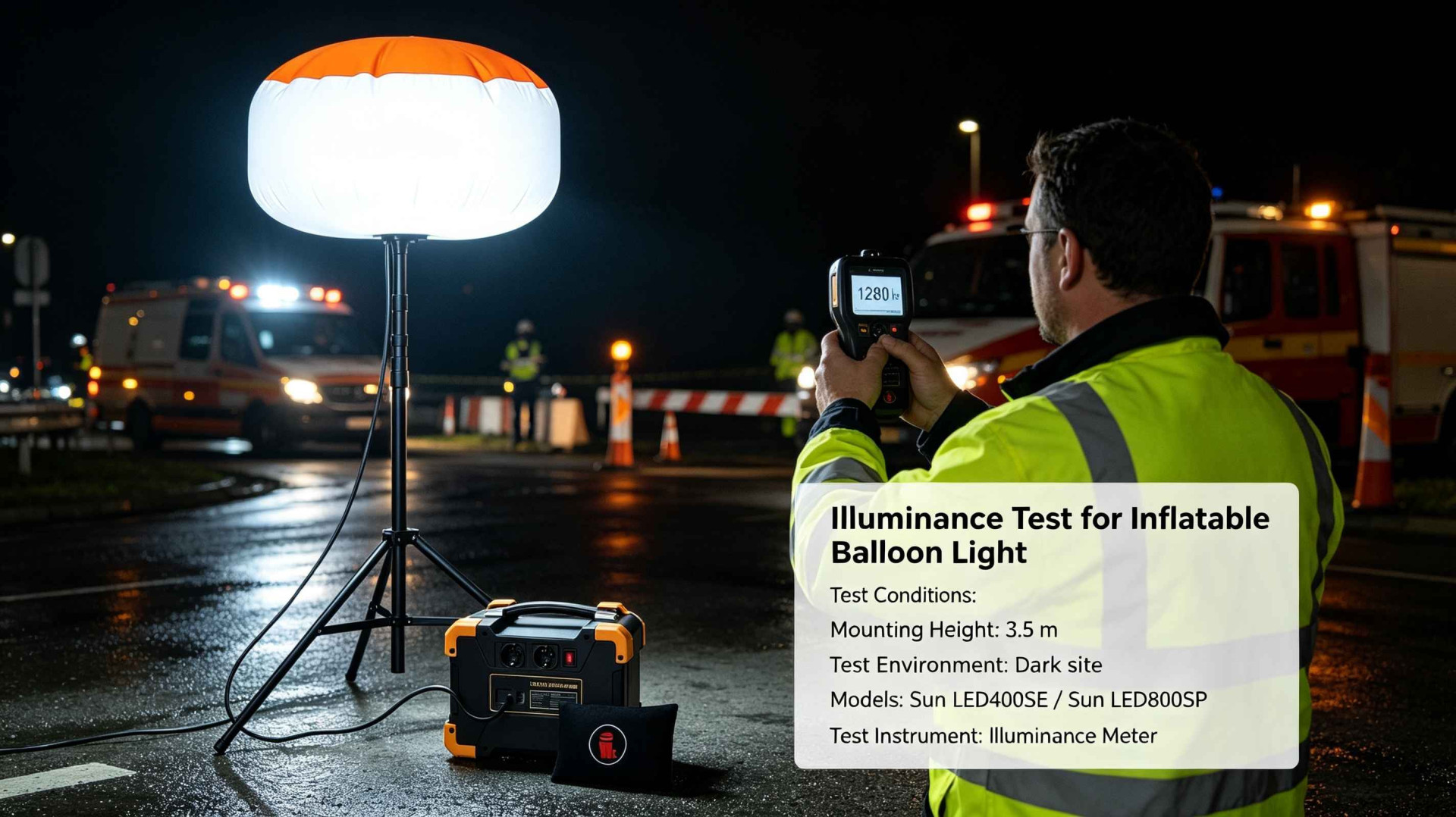
BTCOOPS Sun balloon lighting systems are relevant candidates for construction, roadwork and maintenance applications, subject to model-specific selection.
3.2 Factory Maintenance and Industrial Shutdowns
Industrial facilities often require temporary lighting during scheduled maintenance, machinery inspection and shutdown operations.
Permanent lighting may become inadequate when equipment is dismantled, access platforms are installed or work is performed inside normally restricted areas.
Portable lighting can support:
Mechanical equipment servicing
Production line maintenance
Workshop renovation
Temporary inspection stations
General illumination around maintenance activities
For these applications, buyers should evaluate fixture positioning, electrical isolation procedures, cable protection and whether the work requires a separate low-voltage or specifically rated lighting system.
Lighting used in confined spaces or hazardous areas must meet the applicable site requirements. Standard balloon lights should not automatically be treated as explosion-proof or suitable for confined-space use.
3.3 Warehouses and Logistics Yards
Warehouses, distribution centers and logistics yards can require supplemental illumination during temporary loading, outdoor handling or maintenance.
Lighting requirements depend on the movement of people, forklifts, trucks and materials.
Common project objectives include improving visibility in temporary operating zones, reducing visual discomfort and avoiding unnecessary obstruction of vehicle routes.
Portable balloon lights can be considered for general area illumination, while directional fixtures may be better suited to specific loading docks or inspection points.
Any lighting placed near vehicle movement routes should be protected against collision and positioned in accordance with the site's traffic management plan.
3.4 Road Maintenance and Utility Services
Road maintenance crews frequently work at night or during restricted operating windows.
Their lighting equipment needs to support changing work locations and varying task requirements.
Important considerations include:
Rapid and repeatable deployment
Suitable mounting height
Controlled light spill toward traffic
Reliable power connections
Stable installation under expected wind conditions
Transport and storage efficiency
Inflatable balloon lights offer one possible approach for providing broad, diffused work-area lighting.
However, a suitable lighting layout must still consider road geometry, work-zone regulations and traffic-facing glare.
3.5 Remote Industrial and Agricultural Operations
Remote workshops, agricultural facilities, temporary pumping stations and isolated maintenance sites may lack convenient access to permanent electrical infrastructure.
Lighting selection should begin with an assessment of available power.
Depending on site conditions, options may include AC-powered fixtures, compatible portable power systems, battery-powered lighting or generator-supported arrangements.
For remote operations, the equipment's total energy requirement and operating duration are often as important as its nominal light output.
4. Balloon Lights vs Conventional LED Floodlights
Both inflatable balloon lights and conventional LED floodlights have useful roles in industrial lighting projects.
The best choice depends on the required illumination pattern and site conditions.
| Selection Factor | Inflatable Balloon Lights | Conventional LED Floodlights |
|---|---|---|
| Light distribution | Broad, diffused area illumination | Directional or beam-focused illumination |
| Glare characteristics | Diffuser can reduce direct source brightness | May require careful aiming or shielding |
| Shadow characteristics | Can soften shadows in suitable layouts | May create pronounced shadows from a single direction |
| Typical applications | Temporary work zones and general area lighting | Task lighting, perimeter lighting and targeted illumination |
| Installation | Often elevated on tripods or suitable mounts | Tripod, wall, pole or structure mounting |
| Maintenance | Includes diffuser and inflation-system considerations | Primarily fixture and mounting-system maintenance |
| Site suitability | Depends on enclosure, power and wind ratings | Depends on fixture protection and mounting requirements |
Which is better?
Choose an inflatable balloon light when the project prioritizes broad temporary illumination and reduced direct glare.
Choose a conventional LED floodlight when a defined area requires directional illumination or concentrated task lighting.
For complex industrial sites, combining both approaches may produce a more practical lighting arrangement than relying on a single fixture type.
5. How to Choose Portable Industrial Lighting
A structured selection process helps procurement teams compare suitable equipment without relying only on advertised wattage.
Step 1: Define the working area
Record the approximate length, width, mounting locations and surrounding obstructions.
For example, a 30 m × 20 m temporary work zone has a ground area of 600 m².
However, area alone cannot establish the number or power of required fixtures. Mounting height, distribution, obstructions and target illuminance must also be considered.
Step 2: Define the required illuminance
Illuminance is measured in lux (lx).
Different industrial tasks require different lighting levels. A general access area and a precision inspection station should not automatically be designed to the same target.
Use the applicable project specification, local regulation or lighting standard to determine the required maintained illuminance and uniformity.
Step 3: Evaluate glare and shadow control
Consider the locations of workers, vehicles and sensitive operations.
A lighting layout should avoid excessive direct glare and provide additional task lighting where general area lighting is insufficient.
Step 4: Confirm the electrical supply
Before selecting a product, verify:
Available AC voltage and frequency
Maximum permitted electrical load
Power source and distribution arrangement
Cable lengths and connection requirements
Whether battery or generator operation is necessary
Power compatibility must be confirmed for the exact product configuration.
Step 5: Check environmental and installation requirements
Review the relevant model documentation for environmental protection, temperature range, mounting arrangements and permitted operating conditions.
Wind exposure, dust, moisture and vehicle movements can all influence deployment.
For industrial sites with flammable gas or combustible dust hazards, suitable hazardous-location certification must be evaluated separately.
Step 6: Review transport and maintenance
For projects that involve frequent relocation, consider total packed dimensions, equipment weight, setup procedures, spare parts and servicing requirements.
These factors can influence operational costs over the service life of the equipment.
6. BTCOOPS Product Families for Industrial Applications
BTCOOPS organizes its lighting portfolio around different working environments and project needs.
Rather than treating all lighting products as interchangeable, industrial buyers can begin with the application and continue to the relevant technical product documentation.
Sun Series – Portable Area Lighting for Industrial Worksites
The BTCOOPS Sun family includes balloon lighting configurations intended for construction, maintenance, public works and related temporary lighting applications.
Its diffused lighting concept is relevant to projects where broad work-area illumination and glare control are important.
Potential applications include night construction, industrial maintenance, roadwork and temporary service areas.
Explore: BTCOOPS Sun Series
Columus Series – Mobile Lighting and Temporary Site Operations
The BTCOOPS Columus family includes mobile lighting concepts for temporary worksites, safety operations and field deployment.
Depending on the specific product, power supply and installation arrangement, these systems may be considered for outdoor maintenance, remote work areas and relocatable lighting needs.
Explore: BTCOOPS Columus Series
Supporting Equipment and Power Accessories
Lighting performance in the field also depends on suitable supports, power distribution, cables, transportation arrangements and maintenance accessories.
Industrial buyers should evaluate these components as part of the complete operational setup rather than treating the lighting fixture as the only purchase requirement.
Final product selection should be based on the applicable model datasheet and confirmed operating conditions.
7. Example: Planning Lighting for a Temporary Industrial Maintenance Zone
Consider a hypothetical maintenance contractor preparing a nighttime work area measuring approximately 30 m × 20 m.
The project requires general visibility for personnel movement and separate lighting for mechanical inspection.
The working area has a nearby AC supply and includes several large pieces of equipment that may obstruct light.
A practical planning process would be:
Confirm the applicable illuminance requirements for the working area and inspection tasks.
Identify available mounting locations outside machinery and vehicle routes.
Evaluate elevated diffused lighting for the general work zone.
Add adjustable directional task lights for inspection points.
Check the electrical load, cable routing and protection requirements.
Verify stability, weather suitability and emergency lighting provisions.
Conduct an on-site lighting check and adjust fixture positioning before work begins.
This is an illustrative planning scenario, not a documented installation or a verified lighting design.
Actual fixture quantities and performance must be determined through model-specific photometric data, lighting calculations and site assessment.
8. What Should Industrial Buyers Ask Before Ordering?
A technical purchasing inquiry should include enough information for the supplier to recommend an appropriate configuration.
| Project Information | Why It Matters |
|---|---|
| Intended application | Determines the type of lighting required |
| Area dimensions | Supports preliminary layout assessment |
| Required illuminance | Establishes the lighting performance target |
| Mounting height | Influences coverage and distribution |
| Available power supply | Determines electrical compatibility |
| Indoor or outdoor installation | Affects environmental protection requirements |
| Operating duration | Influences power and reliability planning |
| Transport requirements | Helps identify portable configurations |
| Project country | Supports review of applicable requirements |
| Quantity and delivery schedule | Supports commercial planning |
Buyers should also request model-specific datasheets, available photometric information, installation instructions and applicable compliance documentation.
9. Frequently Asked Questions About Industrial Lighting
What is the best portable lighting for industrial maintenance?
There is no universal best option. Diffused balloon lighting can be useful for general work-area illumination, while directional LED work lights may be more suitable for concentrated maintenance tasks. The choice should be based on the required illuminance, available power and site conditions.
Are balloon lights suitable for night construction?
Yes, appropriately specified balloon lights can be used for temporary illumination at night construction sites. Their diffusers may help reduce direct glare. Installation stability, lighting coverage, electrical protection and work-zone requirements must still be checked.
Can inflatable balloon lights replace LED floodlights?
They can replace some floodlight arrangements where broad, diffused lighting is appropriate. They are not a universal substitute for high-intensity task lighting or carefully directed illumination.
How many lights are needed for a construction site?
The number depends on site dimensions, required illuminance, mounting height, photometric distribution and obstructions. A reliable quantity should be determined through a lighting layout calculation using actual fixture data.
Can portable industrial balloon lights operate outdoors?
Selected models may be configured for outdoor applications. Buyers should confirm the environmental rating, wind limitations, electrical protections and mounting instructions for the exact model.
Are industrial balloon lights explosion-proof?
Not necessarily. A standard balloon light must not be assumed suitable for hazardous locations. Where explosive atmospheres are possible, equipment must be selected with appropriate certification and site-specific approval.
What information should I provide to request an industrial lighting quotation?
Provide the worksite dimensions, application, power supply, required operating duration, environmental conditions, preferred mounting method, quantity, delivery location and any mandatory technical requirements.
10. Plan Your Industrial Lighting Project with BTCOOPS
Industrial lighting should be selected according to the working environment, operational objective and documented equipment performance.
Whether a project involves night construction, factory maintenance, warehouse operations or a temporary remote worksite, a well-defined lighting plan can help buyers identify suitable equipment and avoid mismatched configurations.
BTCOOPS provides access to specialized portable lighting product families, associated equipment and product information for industrial and field applications.
Our selection approach starts with the application: identify the working conditions, assess the lighting objective and then review the relevant product options.
Looking for a portable industrial lighting solution?
Contact the BTCOOPS team with your application details, working-area dimensions, electrical supply and project requirements.
We can discuss relevant product families, available configurations and supporting technical documentation for your review.
Explore Industrial Lighting Applications:
https://www.btcoops.com/industrial-themes/
Browse the Sun Balloon Lighting Series:
https://www.btcoops.com/sun/
Explore the Columus Series:
https://www.btcoops.com/columus/
Contact BTCOOPS:
https://www.btcoops.com/