
Inflatable Art Installations: Design & Buying Guide
Inflatable Art Installations: Design & Buying Guide
How to Choose Inflatable Art Installations for Events, Exhibitions and Commercial Spaces
A Practical Design and Procurement Guide by BTCOOPS
Inflatable art installations are increasingly used as temporary visual features for exhibitions, commercial spaces, live events, shopping malls and creative environments. They allow designers to introduce large sculptural forms, reflective surfaces and illuminated structures without relying exclusively on conventional rigid displays.
However, choosing an inflatable installation involves more than selecting an attractive shape. The right solution must suit the venue, audience experience, installation method, lighting conditions, available budget and long-term operating requirements.
Quick Answer: For visual impact and reflective effects, consider inflatable mirror spheres. For colorful, illuminated installations, choose LED-integrated inflatable sculptures. For exhibitions requiring a distinctive artistic identity, custom inflatable art offers greater freedom in shape and surface treatment. For repeated installations, prioritize durability, packing efficiency, accessible maintenance and a documented setup procedure.
This guide explains how to select, specify and commission inflatable decorative installations for real commercial projects.
1. What Is an Inflatable Art Installation?
An inflatable art installation is a three-dimensional structure that uses air pressure to maintain its intended shape and create a visual, artistic or spatial experience.
Unlike conventional decorative balloons, professionally planned inflatable installations may combine custom sculptural forms, specialized surface finishes, internal lighting, mounting systems and controlled inflation equipment.
Their applications include:
Art galleries and temporary exhibitions
Shopping malls and retail atriums
Fashion shows and product launches
Museums and interactive visitor experiences
Hotels, resorts and hospitality venues
Music festivals and theatrical environments
Seasonal decorations and public art displays
The advantage is not simply that the structures are inflatable. It is the ability to create a large visual form while considering transportation, installation and reuse from the beginning of the project.
2. Which Type of Inflatable Art Is Best for Your Project?
There is no single inflatable product that works for every artistic setting. Selection should begin with the intended visitor experience.
| Installation type | Main visual effect | Suitable applications | Key consideration |
|---|---|---|---|
| Inflatable mirror spheres | Reflection and visual distortion | Fashion shows, galleries, malls | Reflections, lighting and surface protection |
| Illuminated inflatable sculptures | Glowing shapes and color effects | Festivals, exhibitions, hospitality | Lighting integration and electrical safety |
| Custom sculptural inflatables | Original forms and visual narratives | Art installations, museums, brand experiences | Structural feasibility and fabrication |
| Inflatable geometric structures | Repetition and spatial composition | Stage design, exhibitions, architectural displays | Alignment, fixing points and scale |
| Suspended inflatable artworks | Floating or overhead visual effects | Atriums, performance venues, galleries | Certified rigging and overhead safety |
Inflatable Mirror Spheres: Creating Reflective Art
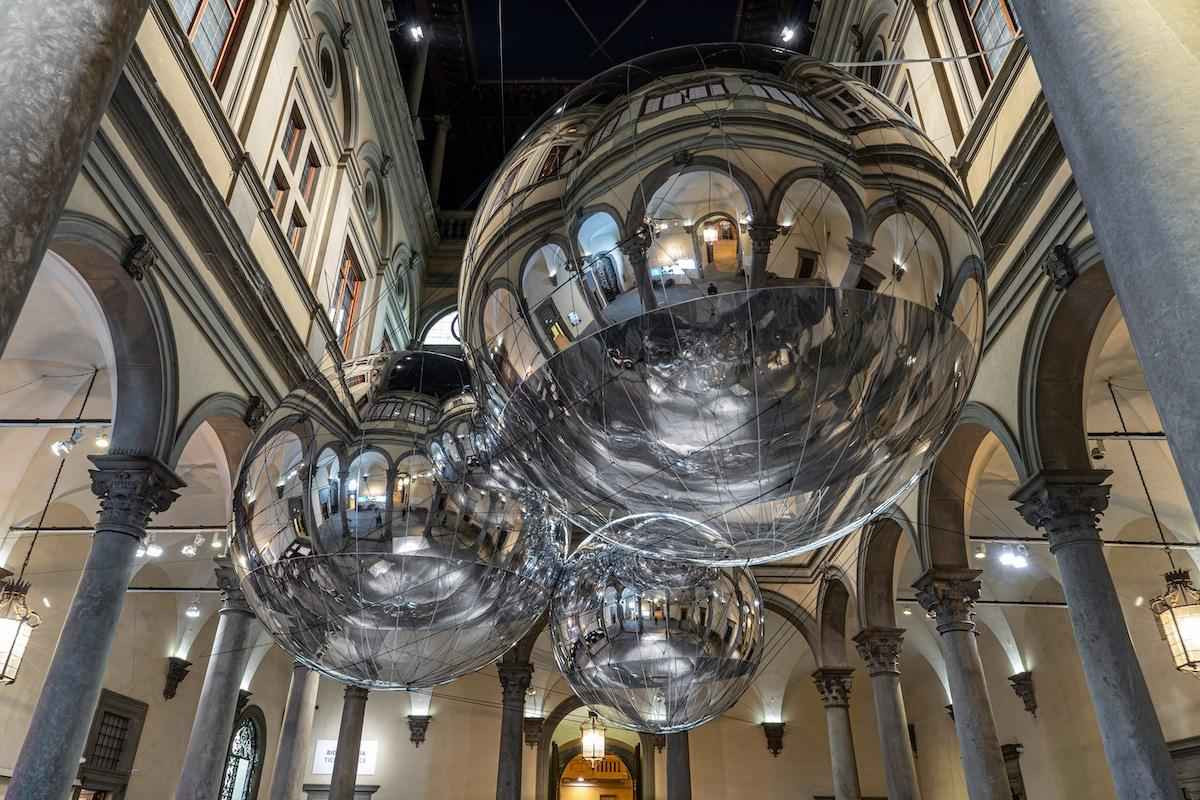
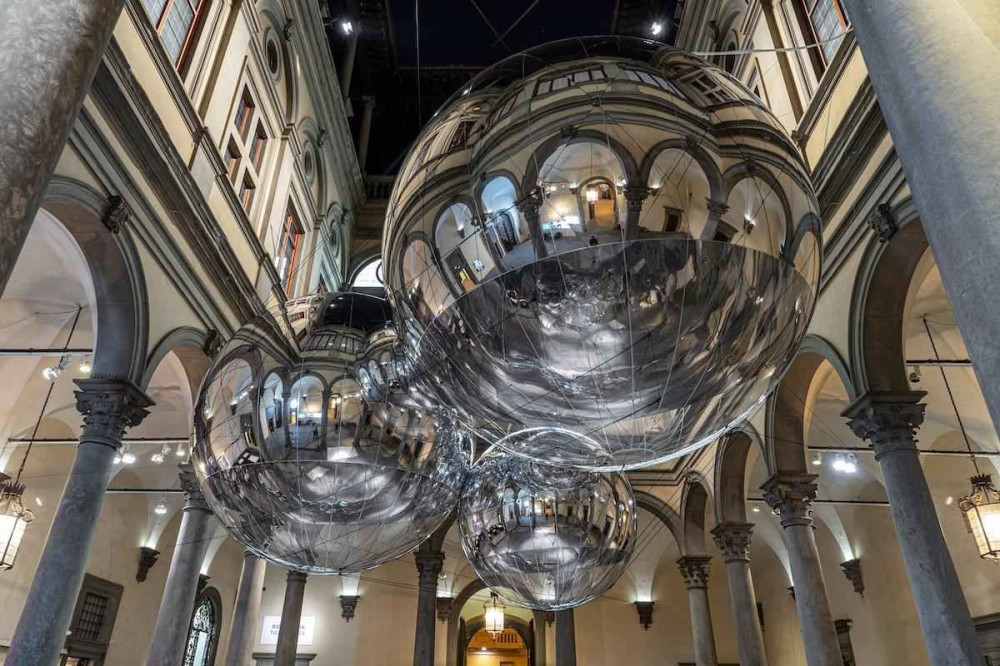
Mirror spheres are particularly effective when the surrounding environment becomes part of the artwork.
A reflective sphere can capture movement, architecture, lighting and people within a single visual object. Multiple spheres can create repetition, perspective changes and immersive visual compositions.
For example, several reflective spheres suspended at different heights may transform a conventional exhibition hall into a dynamic installation.
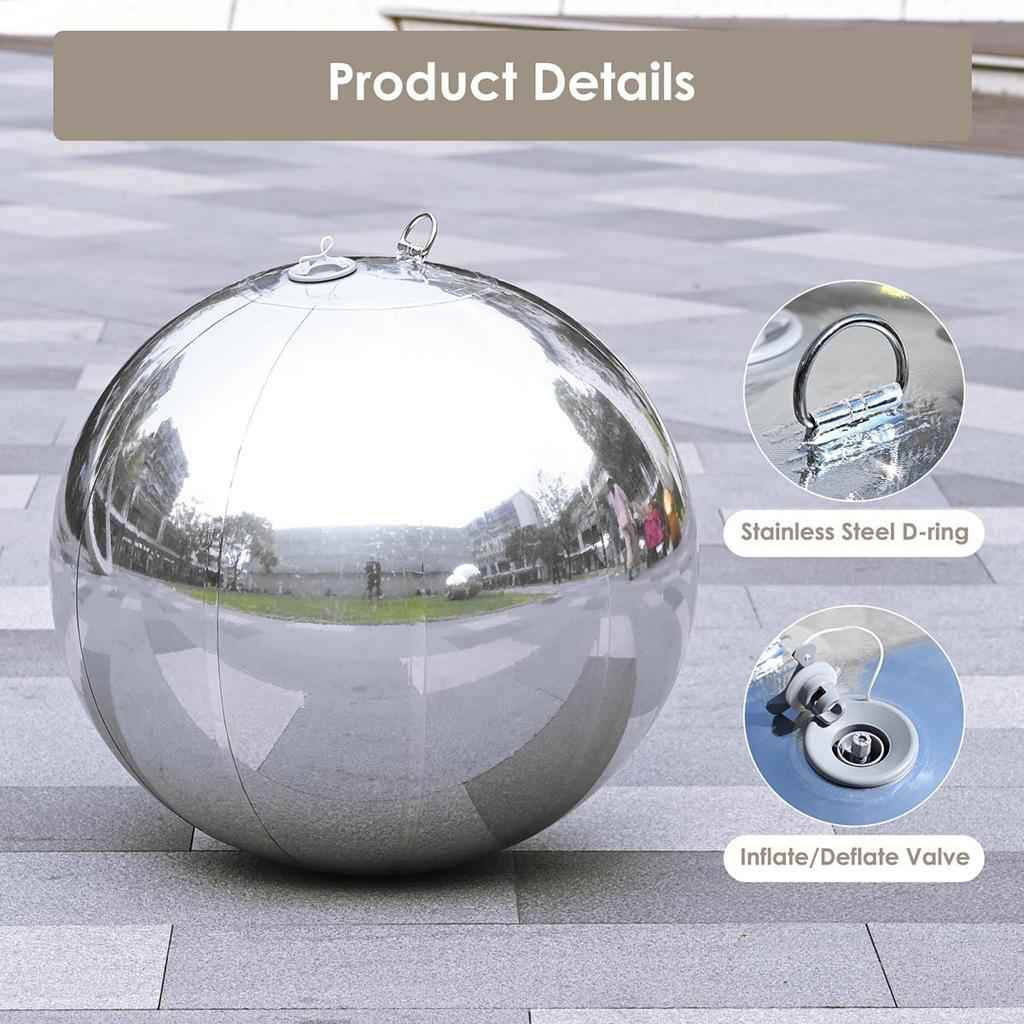
BTCOOPS offers inflatable mirror ball solutions with different sizes, finishes and forms, including options designed for event and artistic applications.
Best suited for: Fashion installations, photographic environments, retail displays and contemporary exhibition concepts.
Illuminated Inflatable Sculptures: Making Light Part of the Artwork
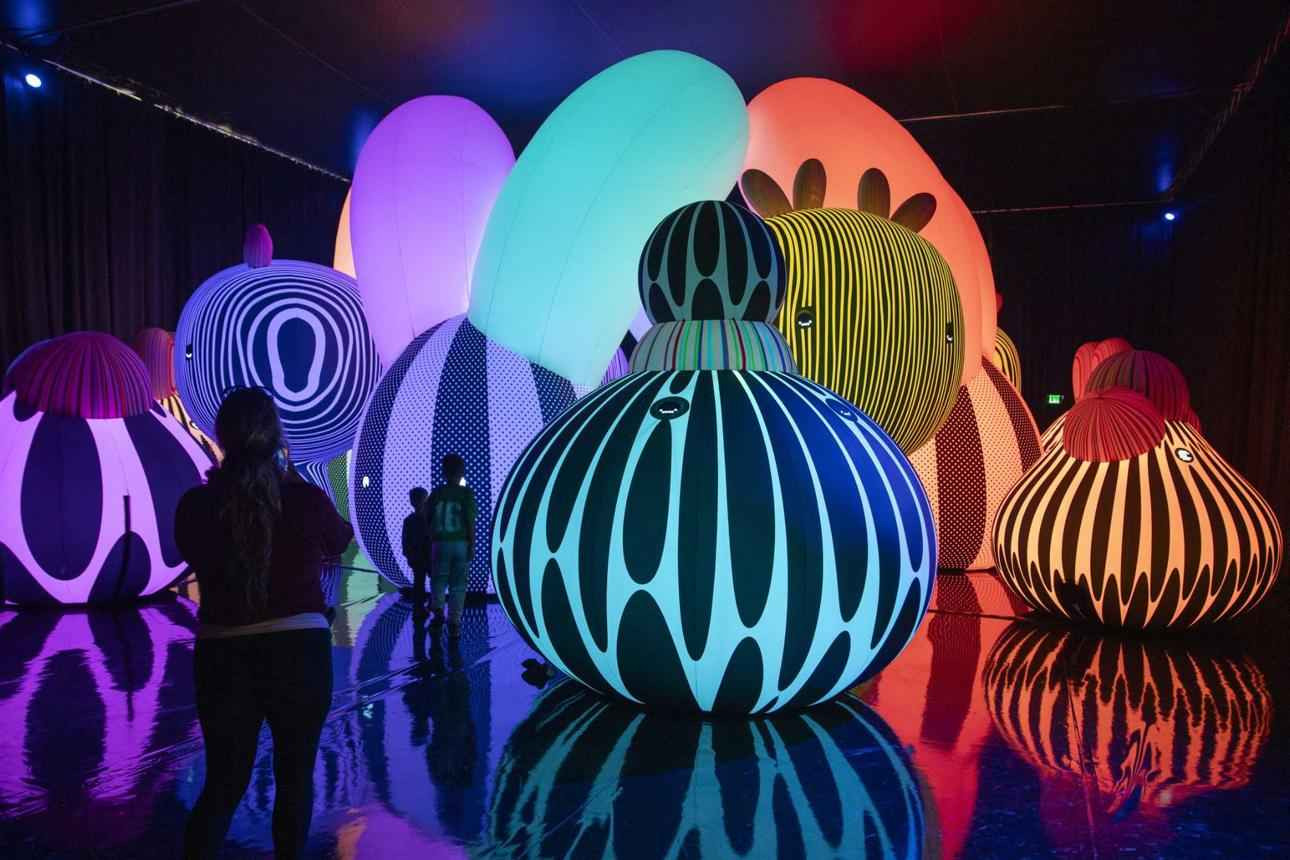
Illuminated inflatable sculptures use light to emphasize volume, color and visual presence.
Depending on the selected product, the lighting may provide a uniform glowing surface, changing colors or a particular decorative effect.
BTCOOPS product families relevant to this category include Aero decorative inflatable lighting, Muse RGBW balloon lights and selected custom inflatable lighting solutions.
These product families serve different purposes. A glowing decorative sculpture should not automatically be treated as equivalent to a professional space-lighting system.
Best suited for: Evening installations, themed events, hospitality environments and temporary illuminated displays.
Custom Inflatable Art: Turning a Design Concept Into a Physical Installation
For artists, exhibition designers and creative agencies, standard spheres and cylinders may not provide sufficient design freedom.
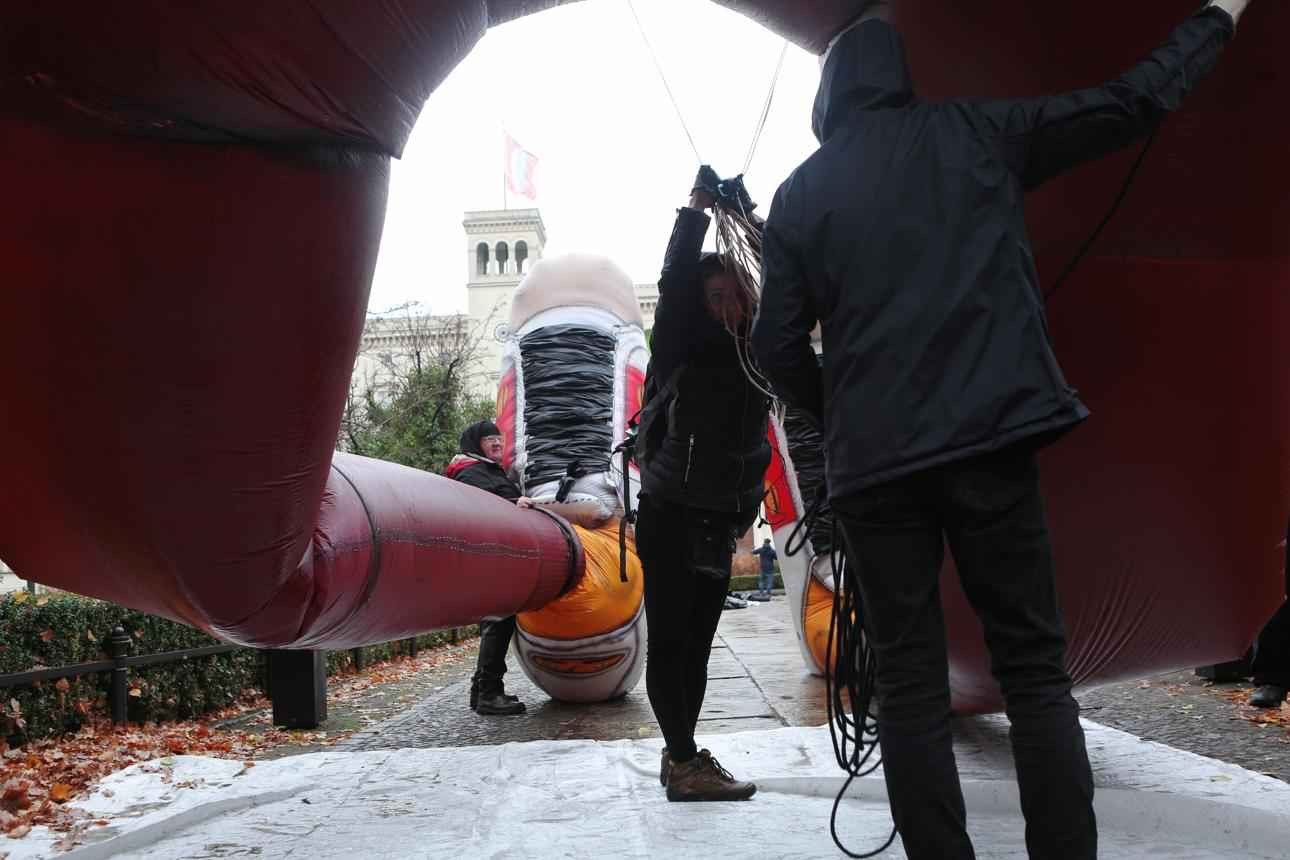
Custom inflatable fabrication may accommodate organic shapes, geometric compositions, oversized objects, themed characters and other sculptural concepts.
The design process should consider the intended dimensions, material behavior, seam placement, inflation pressure, anchor locations and possible restrictions on surface details.
Not every drawing is directly manufacturable as an inflatable structure. Complex shapes may require internal connections, multiple chambers or a revised construction method.
Best suited for: Museums, original artistic commissions, immersive environments and large-scale creative projects.
3. How to Choose Inflatable Art for Different Venues
Art Galleries and Museums
Gallery installations often require controlled visual presentation, minimal disruption and careful coordination with the exhibition environment.
Before selecting an inflatable sculpture, confirm:
Available floor area and ceiling height
Visitor circulation and accessibility
Lighting conditions and reflective surfaces
Noise restrictions affecting inflation equipment
Fire safety and venue material requirements
Whether visitors may touch or approach the artwork
For a gallery where quiet operation is essential, a sealed-air inflatable may be worth evaluating, provided the design can maintain its shape for the required display period.
Shopping Malls and Retail Spaces
Retail installations must often compete visually with signage, storefronts and architectural elements.
Large reflective inflatables and illuminated sculptures can create a focal point within atriums, entrances and promotional zones.
However, mall projects must account for visitor safety, clearance heights, emergency routes, maintenance and restrictions on suspended displays.
For installations used across several promotional campaigns, modularity and reusable finishes can also influence purchasing decisions.
Live Events and Stage Productions
Live events frequently require rapid installation, efficient packing and repeatable assembly.
Inflatable decorative structures can form scenic backgrounds, overhead visual elements or large stage features.
For touring productions, buyers should evaluate the complete operating system rather than the inflatable alone.
This includes mounting hardware, inflation equipment, packing cases, electrical connections where applicable and replacement components.
Outdoor Festivals and Public Art
Outdoor applications require additional engineering attention.
Wind exposure, rainfall, temperature changes, ground conditions, public access and available anchor points can substantially affect the installation design.
A product suitable for an indoor gallery should not automatically be assumed suitable for an outdoor festival.
Outdoor deployment should be based on manufacturer-confirmed environmental limits and a site-specific installation plan.
4. Air-Filled vs. Helium-Filled Inflatable Art
The inflation method directly affects design freedom, operating cost and installation requirements.
| Factor | Air-filled installation | Helium-filled installation |
|---|---|---|
| Typical application | Ground-mounted, supported or suspended sculptures | Floating aerial features |
| Buoyancy | Does not provide useful free lift | Can provide lift when adequately sized |
| Installation | Requires ground support or appropriate rigging | Requires tethering and buoyancy calculations |
| Operating requirements | May use a sealed chamber or continuous blower | Requires suitable gas containment and replenishment planning |
| Recurring cost | Power and maintenance if a blower is used | Helium supply, leakage management and tethering |
| Main limitation | Does not float independently | Lift capacity, weather sensitivity and gas cost |
Which is more practical?
For most indoor decorative projects where floating is unnecessary, air-filled structures are a useful starting point.
Helium-filled installations may be appropriate when the artistic concept specifically requires buoyancy or an aerial effect.
The final decision depends on structural design, material weight, dimensions, site constraints and project operating duration.
5. How to Plan the Size of an Inflatable Art Installation
An oversized structure is not necessarily more effective.
The right scale depends on viewing distance, surrounding architecture, visitor circulation and the visual hierarchy of the installation.
As an initial concept-planning reference, the following size categories may help designers discuss a project:
| Conceptual size | Possible application | Design objective |
|---|---|---|
| Below 1 m | Tabletop display or small artistic arrangement | Close-range detail |
| 1–2 m | Shop windows and smaller gallery displays | Local focal point |
| 2–4 m | Event stages, atriums and exhibition areas | Prominent visual feature |
| Above 4 m | Large venues and public-space concepts | Monumental spatial impact |
These are design categories, not standard product specifications or guaranteed installation limits.
A 3 m suspended sphere, for example, may require significantly more space than its nominal diameter once rigging, clearance and visitor circulation are considered.
For large-scale installations, provide a venue plan with accurate dimensions before finalizing the artwork.
6. Materials, Surface Finishes and Lighting Effects
The material selected for an inflatable artwork influences appearance, durability, weight and maintenance.
Reflective Finishes
Mirror-like surfaces can amplify visual impact by capturing surrounding objects and lighting.
They are especially suitable when reflection and distortion are central to the artistic concept.
However, fingerprints, creases, abrasions and lighting angles may affect the final appearance.
Translucent and Illuminated Surfaces
Translucent materials can distribute light through an inflatable form, creating a luminous visual effect.
Important considerations include material transmission, LED positioning, color uniformity and the potential visibility of internal structural elements.
Printed and Customized Surfaces
Printed surfaces can incorporate patterns, typography or artwork supplied by the designer.
Before production, confirm artwork files, color references, printable areas, seam positions and acceptable visual tolerances.
Material selection should also reflect the required flame-retardancy documentation, cleaning procedures and environmental exposure. Compliance must be assessed for the specific product and installation location.
7. How to Evaluate Installation Safety and Practicality
A successful inflatable artwork must perform throughout the exhibition, not just during the initial setup.
Before approving a design, evaluate five areas.
Structural stability: Determine whether the artwork needs a base, mechanical fixing, overhead rigging, ballast or tethering.
Inflation reliability: Confirm whether the structure is sealed-air or requires continuous airflow. For blower-supported designs, understand the consequences of power loss.
Public interaction: Identify whether visitors can touch the installation and whether protective barriers or additional design measures are necessary.
Electrical safety: For illuminated products, verify the applicable electrical configuration, power supply, cable management and required conformity documentation.
Emergency procedures: Establish procedures for deflation, unexpected movement, loss of power and safe removal.
For suspended or publicly accessible installations, the final arrangement should be reviewed by qualified personnel against venue requirements and applicable local regulations.
8. Reusable Inflatable Art vs. Conventional Rigid Decorations
Inflatable and rigid installations serve different design purposes.
| Evaluation factor | Inflatable art | Conventional rigid sculpture |
|---|---|---|
| Transportation | May pack compactly after deflation | Often requires more fixed transport volume |
| Visual scale | Can create large lightweight visual forms | Depends heavily on structural materials |
| Setup | Requires inflation and appropriate fixing | May require assembly and lifting equipment |
| Surface rigidity | Can move or deform under load | Generally maintains a rigid form |
| Detail reproduction | Limited by materials and construction | May offer greater fine-detail precision |
| Reuse | Depends on handling, material care and construction | Depends on material durability and handling |
| Operating support | May require inflation or monitoring | Typically no inflation system required |
Inflatable artwork is particularly attractive when large visual scale, transport efficiency and temporary installation are important.
Rigid sculptures may be preferable when precise geometry, highly detailed surfaces or permanent structural stability are the main requirements.
Neither option should be selected based solely on purchase price. Transport, installation labor, storage, maintenance and expected reuse should also be considered.
9. What Information Should You Send When Requesting a Custom Inflatable Art Quotation?
A complete project brief helps the supplier evaluate manufacturability and prepare a more meaningful quotation.
Include the following information:
Application: Gallery, mall, festival, brand activation, theater or other venue.
Visual concept: Drawings, sketches, renderings or photographic references.
Dimensions: Desired height, width, diameter and available installation space.
Quantity: Number of units and any repeat orders anticipated.
Location: Indoor or outdoor use, including relevant environmental conditions.
Installation method: Floor-standing, suspended, fixed or floating.
Visual requirements: Surface color, reflectivity, transparency, printing or internal illumination.
Operating duration: Single event, seasonal exhibition or repeated touring.
Technical requirements: Venue standards, electrical supply, rigging restrictions and documentation.
Delivery schedule: Required arrival date and destination.
For highly customized artistic projects, a prototype or material sample may be useful before full production.
10. Working With BTCOOPS on Art and Decorative Installations
BTCOOPS, operated by Wuxi Fenigal Science and Technology Co., Ltd., provides specialized inflatable products and decorative lighting solutions for event, commercial and creative applications.
Relevant product categories include:
Inflatable Mirror Balls: Reflective spheres and decorative forms suitable for visual installations, exhibitions and event environments.
Inflatable Arts: Sculptural and custom inflatable concepts designed around artistic form, surface, scale and installation requirements.
Aero Decorative Lighting: Inflatable decorative lighting that combines sculptural forms with LED-based visual effects.
Muse RGBW Balloon Lighting: Color-controllable inflatable lighting for selected event, creative and decorative applications.
Rather than selecting a product only by its appearance, BTCOOPS encourages designers and procurement teams to begin with the intended environment and required visual effect.
For custom projects, the design concept, manufacturing feasibility and installation requirements should be reviewed together.
Frequently Asked Questions
Are inflatable art installations suitable for museums?
Yes. Inflatable installations can be considered for temporary exhibitions, immersive displays and sculptural environments. Museums should evaluate surface materials, blower noise, visitor access, environmental conditions and the required conservation or installation procedures.
Can inflatable mirror balls be customized?
Inflatable mirror balls may be available in different sizes, colors, shapes and surface finishes. Customization feasibility depends on the specific material, geometry, installation method and production requirements.
Can inflatable art be used outdoors?
Some inflatable artworks can be designed for outdoor use, but suitability must be assessed individually. Wind exposure, anchoring, environmental protection and public safety are essential considerations.
Do inflatable art installations need continuous electricity?
Not always. Sealed-air designs may retain their shape without a continuously operating blower, while constant-air structures require ongoing airflow. Illuminated artworks also require an appropriate lighting power supply.
What is the difference between an inflatable sculpture and an inflatable advertising balloon?
An inflatable sculpture primarily emphasizes artistic form, space and audience experience. An advertising balloon emphasizes brand recognition and promotional messaging. A project can combine both functions, but the design objectives are not identical.
Are inflatable installations reusable?
Many inflatable installations can be designed for repeated use. Their service life depends on materials, construction, environmental exposure, installation methods, cleaning, packing and maintenance.
How much does a custom inflatable art installation cost?
The price depends on size, shape complexity, materials, surface finish, illumination, inflation method, mounting accessories and order quantity. A project-specific quotation is more useful than a generic price per meter.
What should I prepare before contacting a manufacturer?
Share the visual concept, approximate dimensions, venue conditions, intended installation method, quantity, expected operating duration and delivery schedule. These details help determine whether an existing design can be adapted or a custom solution is required.
Conclusion: Design Around the Experience, Not Just the Object
The most effective inflatable art installations combine creative expression with practical engineering.
Reflective spheres, illuminated sculptures and customized inflatable forms can all contribute to memorable exhibitions, commercial environments and event experiences. The best choice depends on the desired visual effect, venue conditions, operational needs and available resources.
For artists, event producers and commercial designers, the starting point should be a clear project brief rather than a product model.
Planning an inflatable art installation?
Explore BTCOOPS inflatable artwork and decorative lighting solutions, or contact our team to discuss your concept, required dimensions, installation conditions and customization needs.
BTCOOPS | Wuxi Fenigal Science and Technology Co., Ltd.
Website: https://www.btcoops.com
Art & Decoration Resource Center: https://www.btcoops.com/art-decoration/
Inflatable Art Solutions: https://www.btcoops.com/inflatable-arts/
Inflatable Mirror Balls: https://www.btcoops.com/inflatable-mirror-balls/
Muse Lighting: https://www.btcoops.com/muse/